
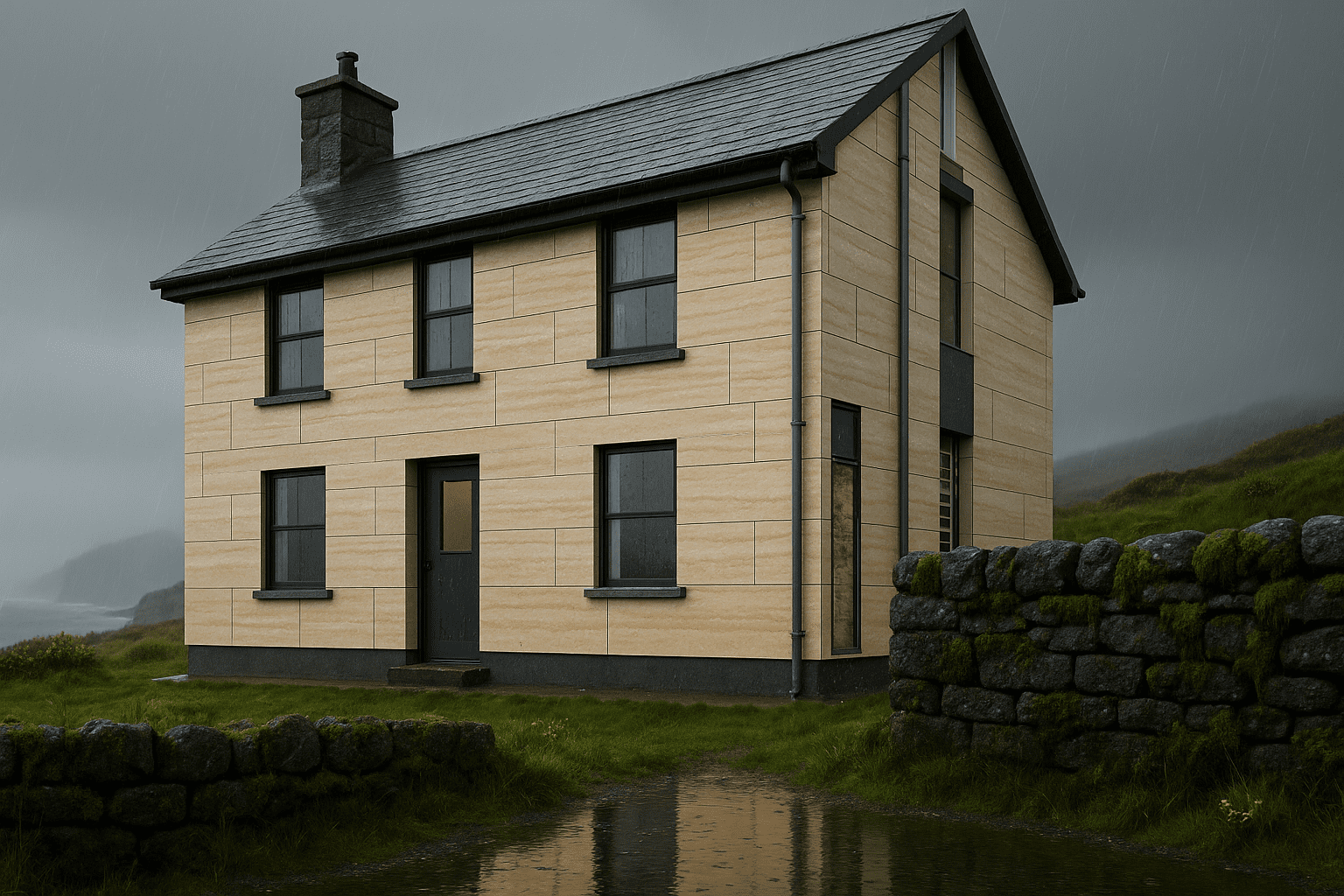
Humidity & Bio-Growth Risks
Ireland’s green landscapes come with steady rain, mist, and sea air. That moisture settles on building walls, and two things soon follow:
- Mold & algae leave dark streaks.
- Freeze-thaw damage appears when trapped water turns to ice in winter.
Natural stone—especially porous travertine—soaks up water like a sponge, giving spores the perfect home. Owners end up power-washing every year and paying for new sealers.
HPL Anti-Mold Surface Tech
Samrat’s travertine-look High Pressure Laminate (HPL) panels solve this in three ways:
- Sealed, non-porous face – water can’t soak in, so spores can’t root.
- Silver-ion additive in the top coat – slows down mold and algae growth.
- UV-stable print layer – colour stays true even after harsh jet-washing.
Result? A wall that keeps its warm stone look without turning green.
Quick Annual Cleaning Checklist
| Month | Task | Time Needed |
|---|---|---|
| April | Hose down panels with garden sprayer; mild soap if dusty | 30 min |
| October | Visual check of joints and sealant beads | 15 min |
No pressure washers, no harsh chemicals. If a stubborn spot appears, a soft brush plus dish soap is enough.
Total Cost-of-Ownership (TCO) – 15-Year Snapshot
| Item | Natural Travertine | Travertine-Look HPL |
|---|---|---|
| Up-front supply & fit | €240 / m² | €190 / m² |
| Yearly cleaning gear | €1.50 / m² | €0.50 / m² |
| 5-year reseal | €6.00 / m² | — |
| Small patch repairs | €3.00 / m² | €1.00 / m² |
| 15-year total | ≈ €310 / m² | ≈ €205 / m² |
Choosing HPL saves a typical Irish homeowner about €105 per square metre over 15 years—enough to pay for new gutters or that garden deck you’ve wanted.
Key Take-Aways for Irish Homeowners
- Less scrubbing – sealed surface stops mold roots.
- No resealing bills – coatings last the panel’s life.
- Colour that stays warm and bright – even in Atlantic rain.
- Over €100 / m² lower cost across 15 years.
Travertine-pattern HPL gives you the charm of natural stone—without the endless upkeep that Ireland’s damp weather demands.